Screen vs projector for events: which to choose?
Key takeaways
- ✦A bright 4K LCD screen stays sharp and readable in a lit room, where a projector image washes out and loses contrast.
- ✦A projector only wins at very large formats in a darkened room, where size matters more than brightness.
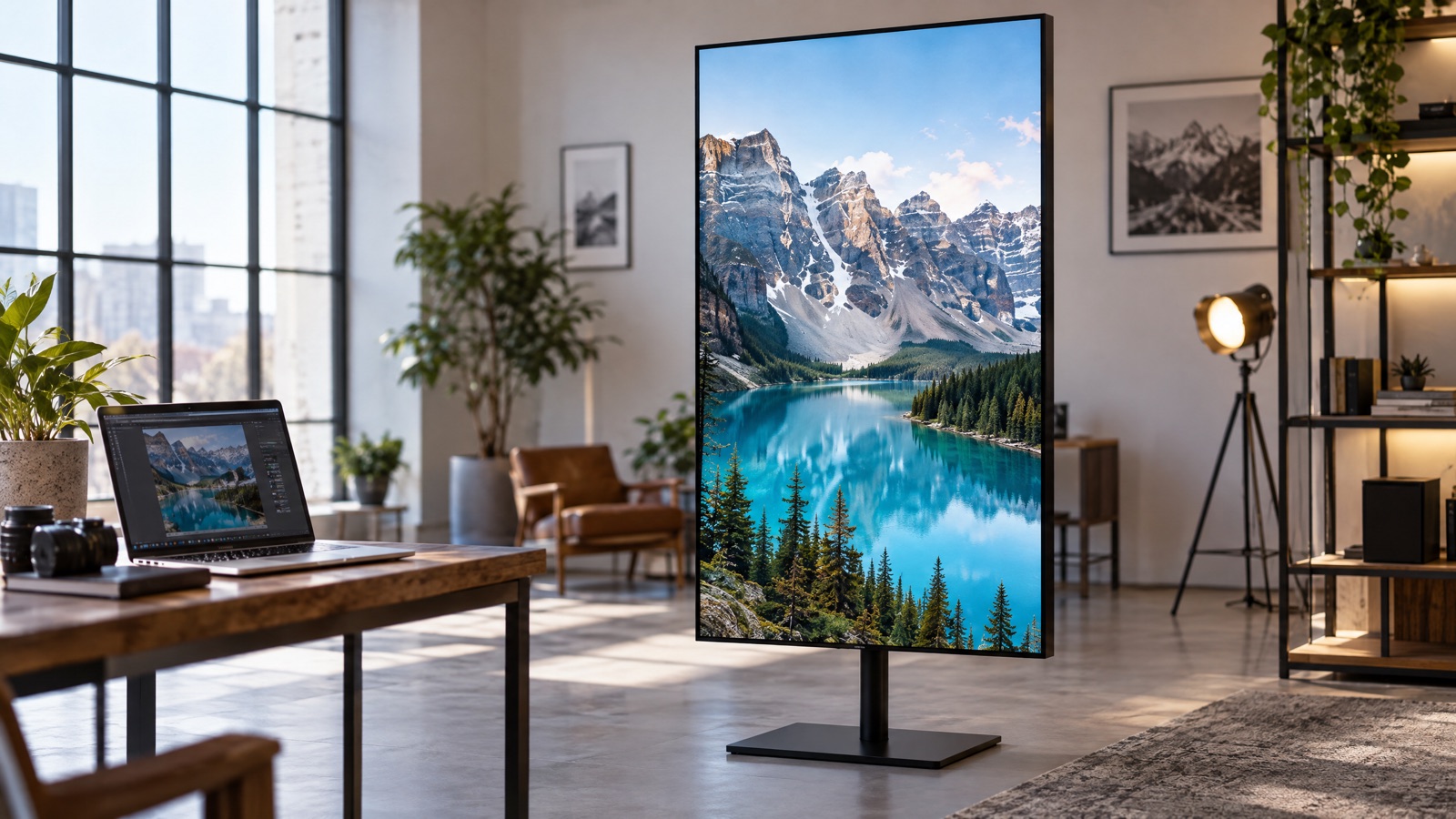
- ✦VACANT's 65-inch screen runs at 3000 nits, bright enough for any conference hall with the lights on and windows nearby.
- ✦The screen is plug-and-play on a wheeled stand; a projector needs blackout, focusing and a white projection surface.
- ✦For most lit event rooms, an LCD screen is the more reliable, sharper and simpler solution.
VACANT provides digital screen rental in Riga — 65-inch 4K screens for events, exhibitions and conferences from €30/day.
Screen vs projector for events: where to start
Screen vs projector is one of the first choices you face when planning a conference, presentation, exhibition or shop-window campaign. Both solutions put an image in front of a large audience, but they were built for different conditions. The short answer is simple: a projector shines in a large, darkened room where size is what matters, while a bright 4K screen almost always wins in a lit room where people look at detail. In this article we compare the two fairly, and in more depth than most, so you can choose correctly for your own event.
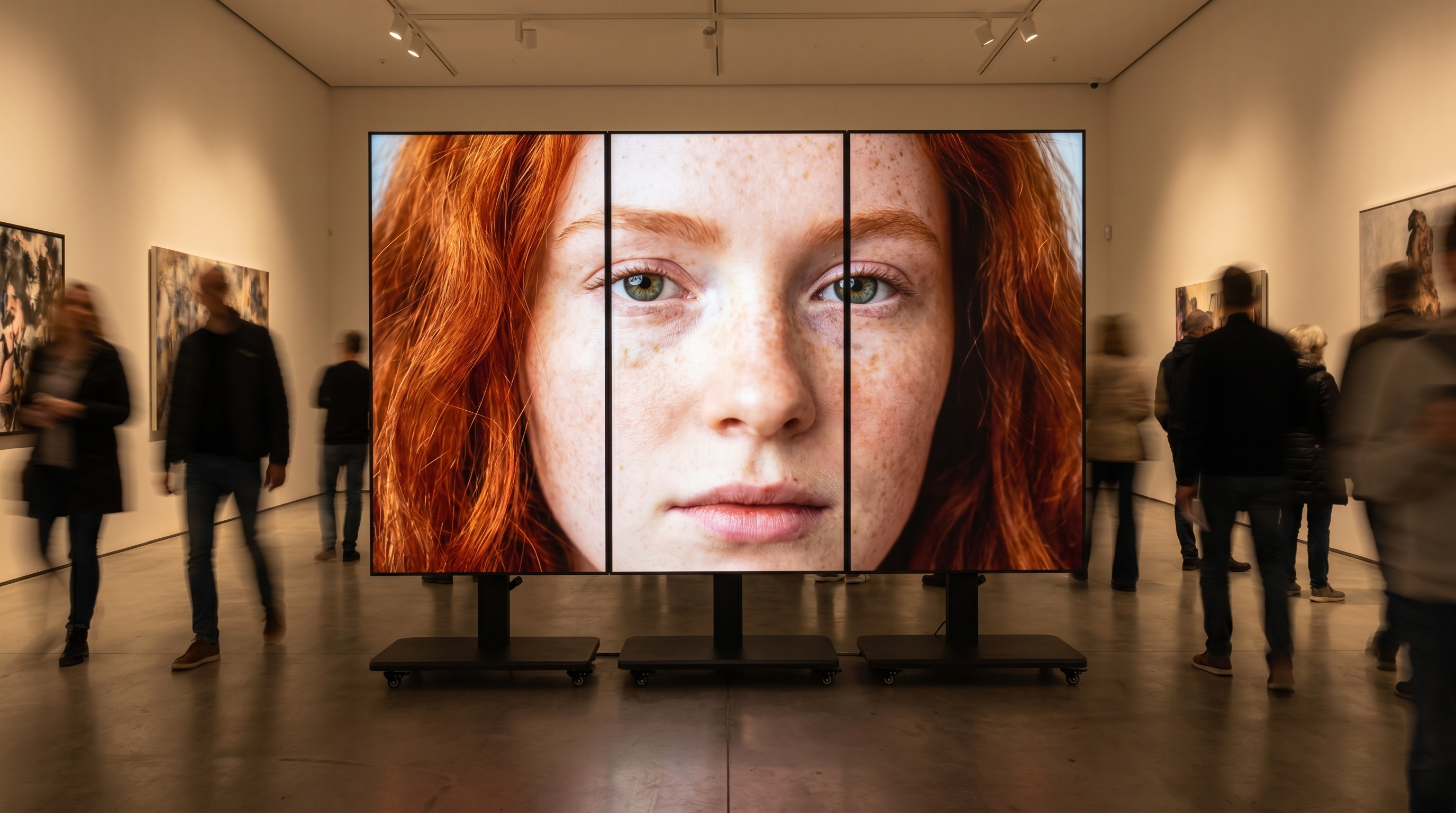
Quick comparison
| Criterion | LCD screen (VACANT 65" 4K) | Projector |
|---|---|---|
| Brightness in a lit room | 3000 nits, image stays sharp | Washes out, loses contrast in light |
| Sharpness and 4K detail | 4K panel, readable small type | Depends on surface and focus, softer |
| Setup | Plug-and-play on a wheeled stand | Needs blackout, focus, a surface |
| Reliability | No lamp, no overheating | Lamp, fans, risk of shadows |
| Maximum size | Up to 10 panels in a wall | Very large single image |
| Rental cost | Lower, no installation | Cheaper unit, but hidden costs |
| Best use | Lit rooms, close viewing | Large format in a darkened room |
Brightness and ambient light
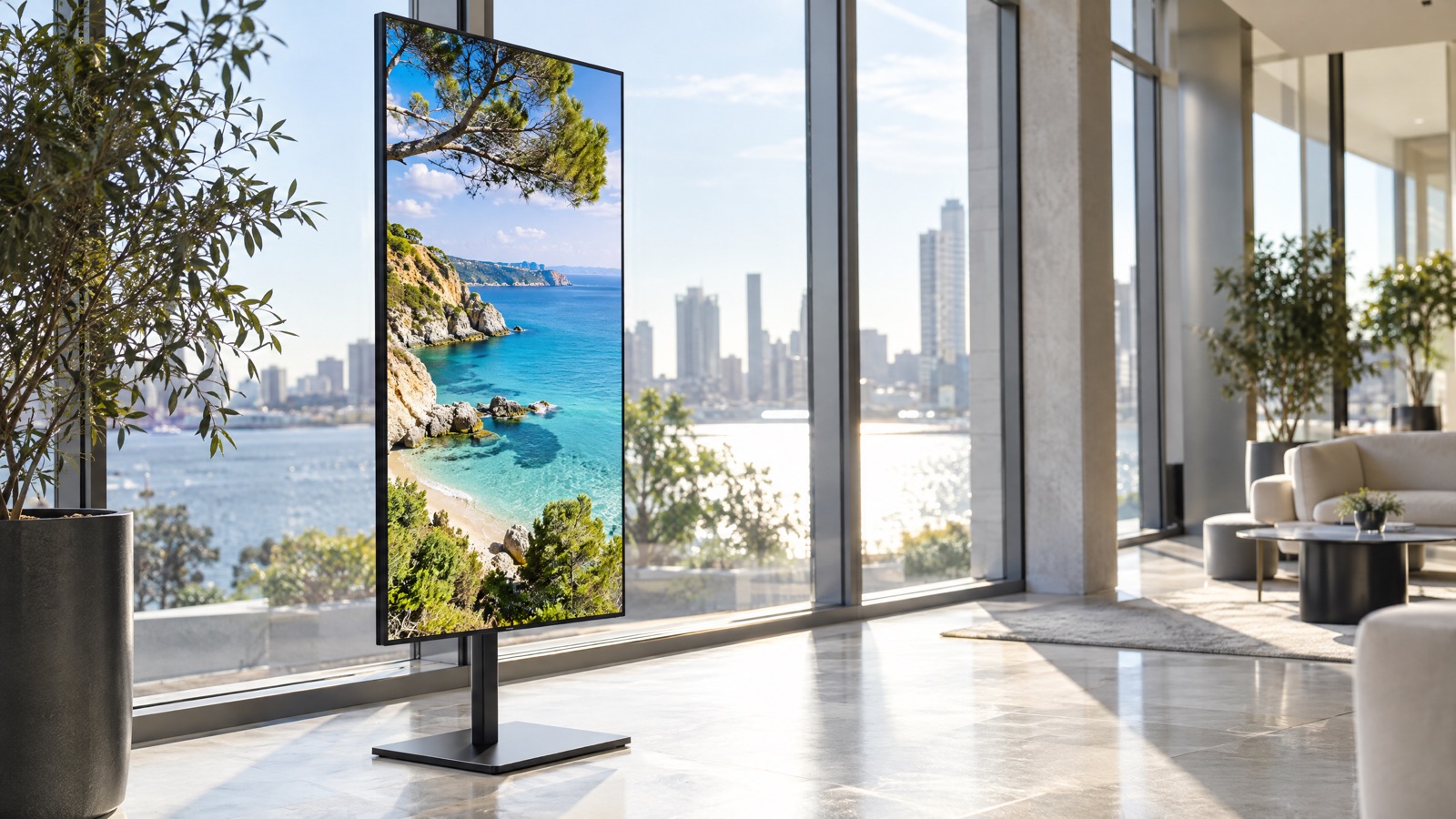
Brightness is where a screen and a projector differ most clearly, and it's the thing most often misjudged. An LCD screen emits light itself — VACANT's panels are 3000 nits, which is very bright, so the image stays sharp and high-contrast even when the room lights are on and daylight comes through the windows. A projector works the opposite way: it throws light onto a surface and relies on the room being dark enough. As soon as ambient light is added, the projector image turns dim, greyish and loses its black depth.
In practice that means in most real event rooms — conference halls with ceiling lights, exhibition halls, offices and shop windows — a screen simply looks better. People see the content rather than a faded projection, and nobody has to close the blinds or kill the lights to make the slides readable. For a projector that dependence on darkness is built in — it isn't a fault, it's the limit of the technology.
Simple test: if the room will keep its lights on or the sun comes through the windows, you almost certainly want a screen.
If you're planning an event in a lit room and want a reliable solution, you can rent bright screens from VACANT from a single day, and combine up to 10 identical panels into one wall when you need more surface.
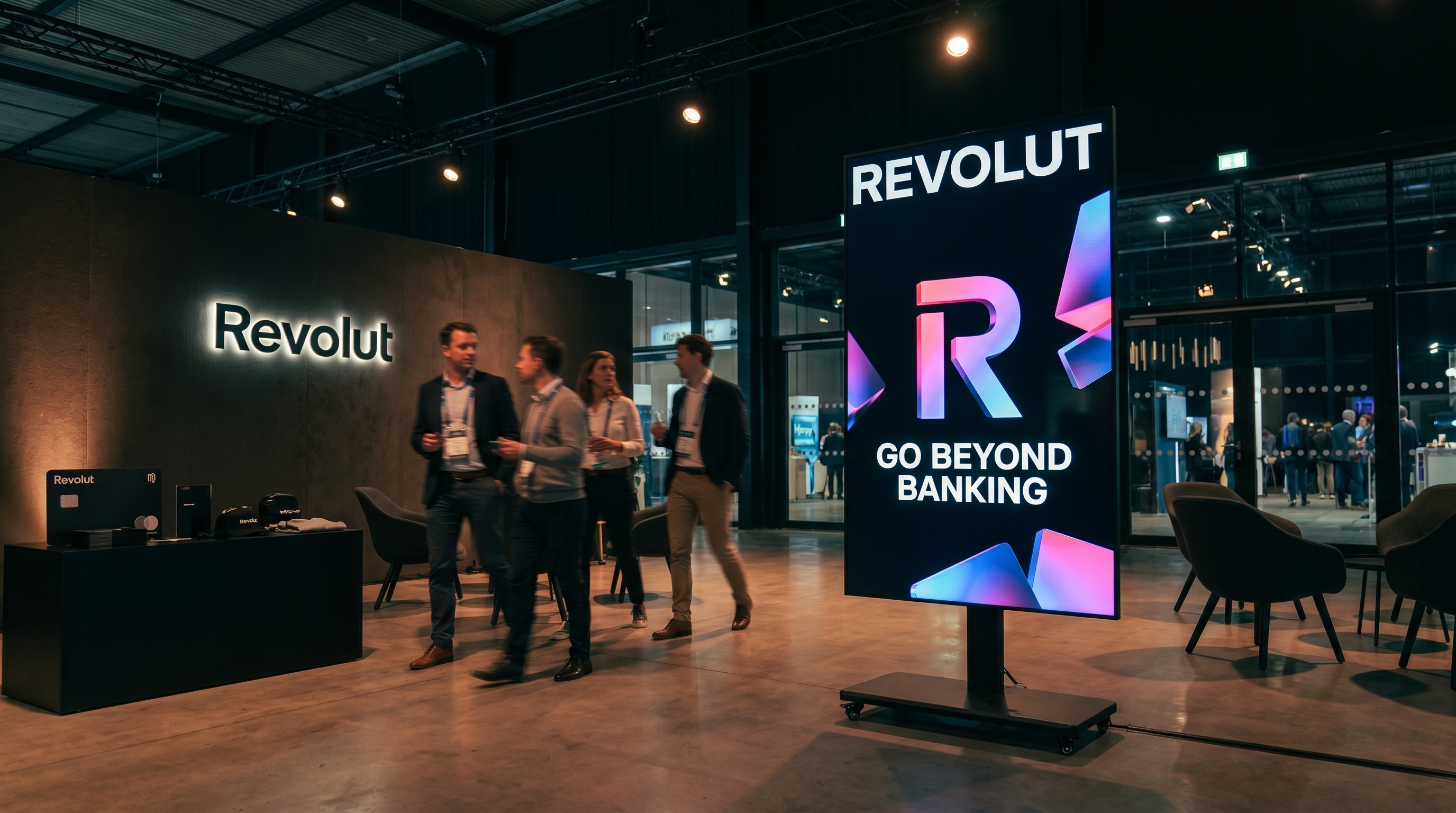
Sharpness, setup and reliability
After brightness, the next big difference is sharpness. VACANT's 65-inch (165 cm) 4K UHD professional screen VCNT SL1 is a single continuous IPS panel that shows smooth fine text, crisp lines and accurate colours from any angle. You can put your nose right up to it from 30 cm away and the image is still sharp. A projector's sharpness, by contrast, depends on focus, throw distance and the surface: an uneven or grey wall, a slight defocus or a keystone correction, and the small text goes soft.
Setup and reliability differ just as clearly. The screen is plug-and-play: it arrives on a wheeled stand with HDMI and power, you switch it on and you're running — no blackout, no focusing, no hunting for a projection surface. A projector needs a stand or rig assembled, the image aligned, a clean white surface found, and care that no speaker walks through the beam and casts a shadow. The screen has no lamp that can burn out, no fans humming, and no overheating risk across a long day. That simplicity is exactly what makes the screen the safer choice when an event has to run without surprises.
Screen vs projector: which to choose
Two things decide it — ambient light and the size you need. If the room will have light and viewers will look at detail (in a conference hall, at an exhibition stand, at a presentation or by a shop window), choose the screen. You get a brighter, sharper image and far simpler logistics. If instead you need a genuinely huge image in a darkened room with no windows — for a film screening, a large backdrop projection or surface mapping — a projector is the right call, since one of them can cover a wall several metres wide.
For most lit event rooms, the screen wins: it looks brighter and sharper, and it's easier to set up. The projector stays king where you need a large format and the room can be darkened. So when you weigh screen vs projector, ask yourself one thing first: will the room keep its lights on?
It's also worth being honest about audience size. A single 65-inch screen reads cleanly for a stand, a meeting room or a few dozen seats; past that you either move people closer, add a second screen, or combine panels into one wall. A projector covers a big crowd in a single throw — but only if the room is dark enough. Matching the format to both the light and the headcount is what keeps the image working for the whole event.
Event type and recommended solution
| Event type | Recommended solution |
|---|---|
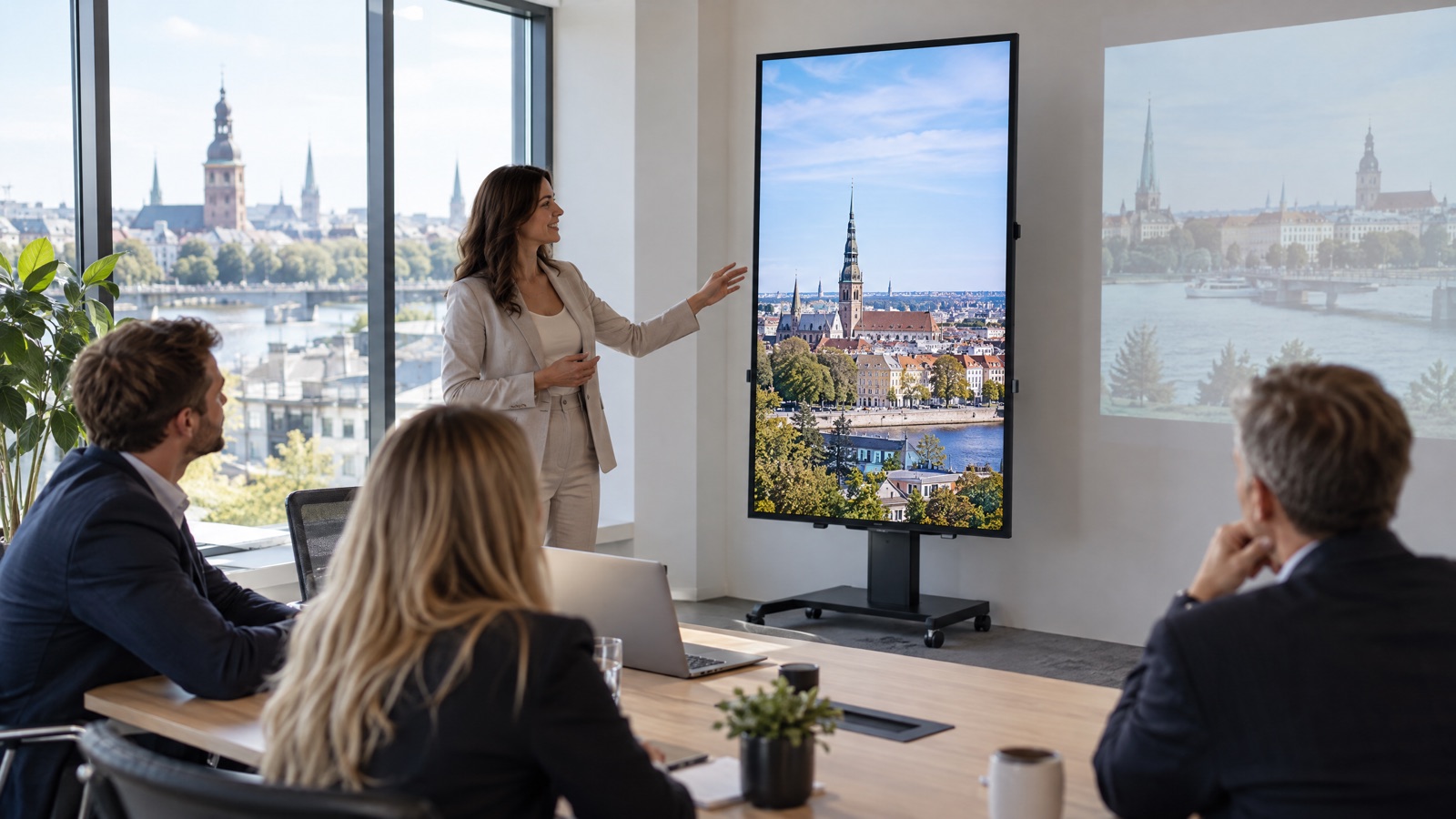
| Conference, presentation | Screen |
| Exhibition stand | Screen |
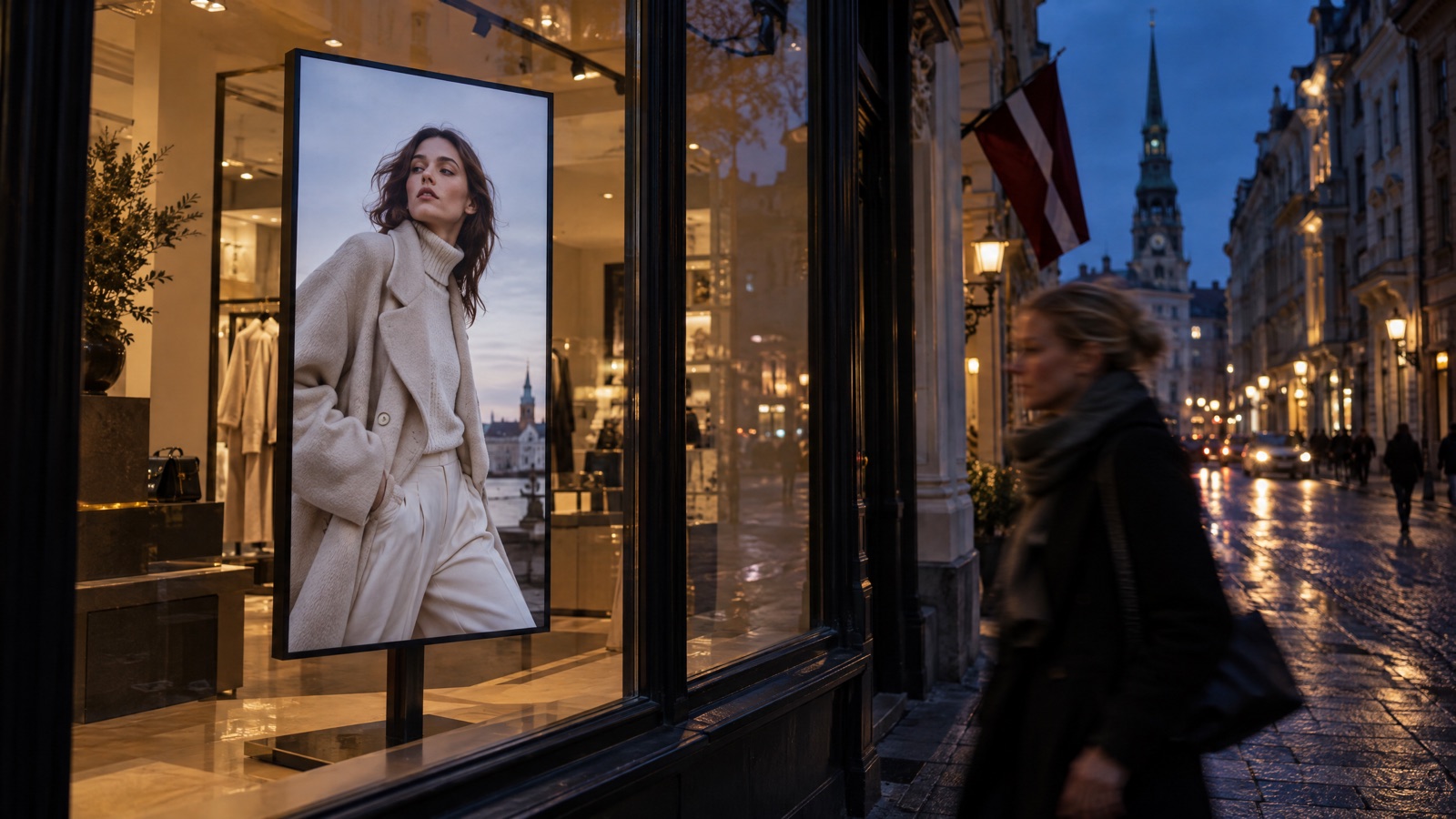
| Shop window | Screen |
| Indoor product launch | Screen |
| Film screening in a dark hall | Projector |
| Large projection with no windows | Projector |
| Surface mapping on a wall | Projector |
Cost and logistics: what each choice really costs
At first glance a projector looks cheaper, because the unit itself costs less. But the real cost of the event is often different. A projector may need extra spend on blackout, a projection screen or surface, rigging and sometimes a technician to align the image — and if the room can't be darkened enough, the result will be dim anyway. With screen rental the price is transparent and linear: one daily rate per screen, with no separate installation fee and no minimum order.
On logistics, the screen is deliberately simple. The VACANT screen on its wheeled stand is self-pickup in Riga, rolls easily across a flat floor, and can be set up in a day with no outside crew. You can also budget it in seconds: the rate is per screen per day — from 50€ for 1–6 days, dropping to 40€ for 7–29 days and 30€ from 30 days, with optional insurance at +20€ per day (capped at 200€). If you need a larger surface in a lit room, combining several screens into a wall keeps the bright, sharp image — a convenient alternative to a projector where it couldn't be darkened enough. That predictability — together with the brightness and sharpness — is why, when you weigh screen vs projector for an indoor event, the screen so often turns out to be the smarter option.
Conclusion: ready to rent a screen for your event?
When you compare screen vs projector, it comes down to light and size: in a lit room and up close, choose the screen; for a very large image in a darkened room, choose the projector. If your event is in a room with light and viewers will be near, VACANT's 65-inch 4K LCD screen is a simple, safe solution. Rental starts from 50€ per day (excl. VAT), with a wheeled stand, HDMI and power included, and you can combine up to 10 screens into one wall. Browse the available screens and rental terms here or message us on WhatsApp at +44 7397 311 066 — we'll help you pick the right setup for your event.
Frequently asked questions
What's better for an event — a screen or a projector?+
For most lit indoor events — conferences, presentations, exhibitions and shop windows — a screen is the better pick: the image stays sharp and readable with the lights on, and setup is simple. A projector only wins when you need a very large image in a darkened room.
Doesn't a projector give a bigger image than a screen?+
A single projector really can throw a very large image on a wall, and that's its main advantage. But as soon as there's light in the room, that large image turns dim and low-contrast. VACANT screens can also be combined — up to 10 identical 65-inch panels into one wall — when you need a larger but still bright surface.
How much brighter is a screen than a projector?+
VACANT's LCD screens run at 3000 nits, and the panel emits that light itself. A projector reflects light off a surface, so ambient light easily overpowers it. In a lit room a screen looks noticeably brighter and higher-contrast than a typical event projector.
Can you use a screen in a lit room?+
Yes. That's the screen's main advantage: a 3000-nit image stays sharp and readable with the lights on, next to windows and in daylight. A projector in the same conditions would usually need the blinds closed or the lights off.
How much does screen rental cost for an event in Riga?+
VACANT screen rental starts from 50€ per day (1–6 days, excl. VAT), 40€ per day for 7–29 days and 30€ per day from 30 days. Each screen comes with a wheeled stand, HDMI and power, with no separate installation fee.
When is a projector the better choice after all?+
A projector is worth choosing when you need a genuinely large image — several metres wide — in a darkened room: a film screening, a big backdrop projection in a windowless hall, or surface mapping. Where there's size and darkness, a projector is in its element.
Need screens for your event?
65-inch 4K screens from €30/day. Transparent pricing, everything included, easy pickup in Riga.
See pricing & book →Marketing expert and founder of VACANT. Specialises in digital marketing and advertising, helping brands stand out with digital-screen campaigns.